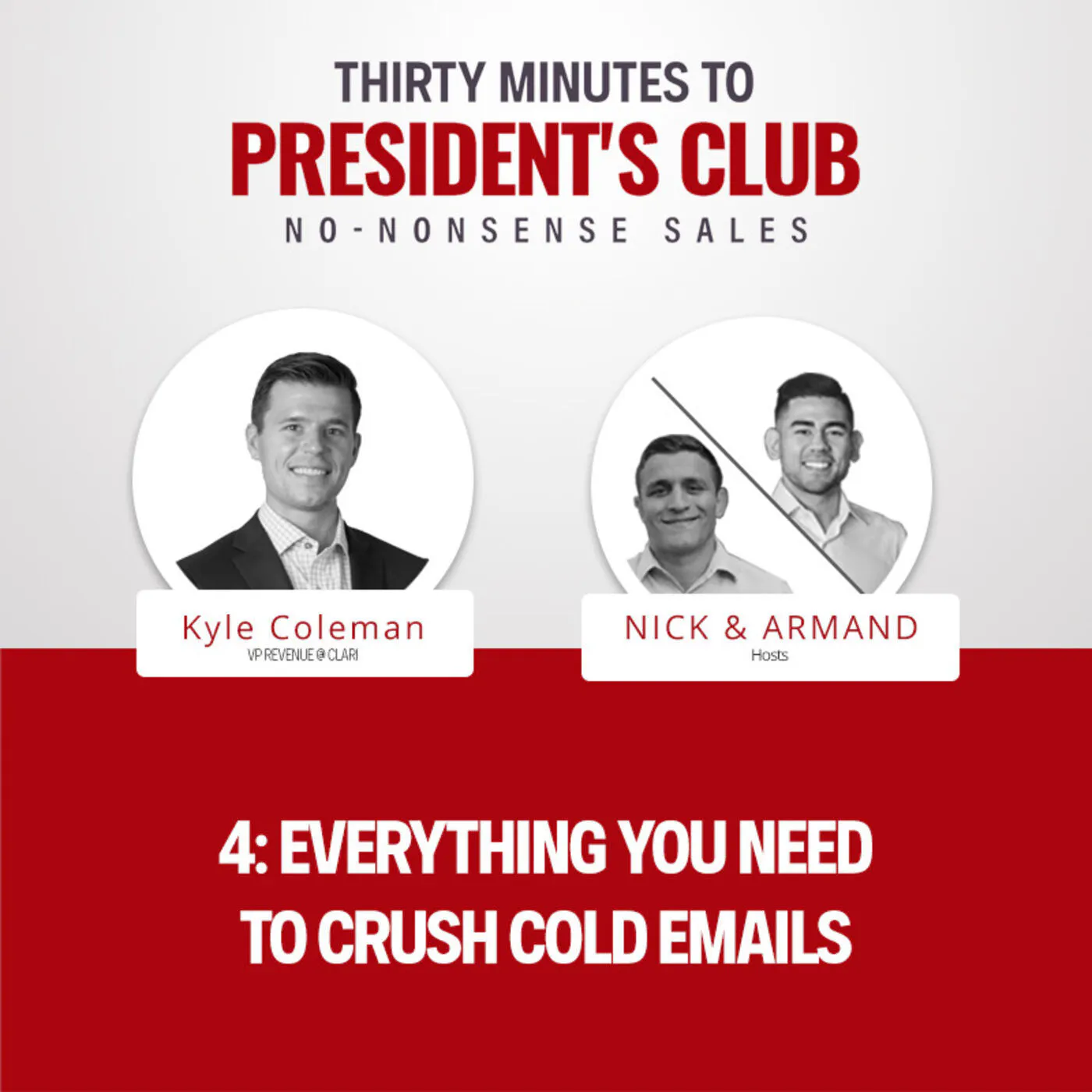
Podcast episode
Everything you need to crush cold emails (Kyle Coleman, VP Revenue @ Clari)
30 Minutes to President's Club20 May 202027 min
Description
Join the most tactical sales newsletter in the world: https://hubs.ly/Q01-R33G0 Four Actionable Takeaways: 5x5x5: 5 minutes of research. Find 5 insights on the person/account. Write your message in 5 minutes. Use whitespace in your emails and have 1 idea per line. Make the structure and the tone conversational Keep your emails short. If you have to scroll more than once or if an email is over 125 words, fix it. Have your voicemails reference your emails and vice-versa. It boosts your reply rates. Kyle Coleman’s Path to President’s Club VP, Revenue Growth & Enablement @ Clari Sr Director, Sales Development & Optimization @ Looker A massive LinkedIn following with killer content RESOURCES DISCUSSED Join our weekly newsletter Things you can steal 30MPC Training: 30mpc.com/training
Show moreShow less
Listen
Loading the recording
This recording could not be loaded.Open the audio file
Quoted on this wiki
Every place a page here uses this source, in the order the words come in it.
Do it all over again. Love it. What's number two, Kyle? Number two, a Chris Voss special. You have to get comfortable in any sales role, SDR, inside sales, enterprise sales. Get comfortable mirroring. This is when you're handling an objection. Just repeat the last few words that the prospect just said to you. Repeat it back to them. “So when they say, you know, I'm not interested, just say not interested and see what happens.” It's incredible when you just mirror those last couple words and just shut up and allow them to talk the amount of information that they will give you. So get comfortable mirroring. Love that one. Round us out. What's number three, Kyle? Number three, time is your most precious asset.
I think what we've landed at is a max of three voicemails. Because if you've left like seven voicemails, eventually it's like, you're just wasting your time talking to yourself. But the first one, we would do exactly what you're talking about, where we would lead with context and we would stop. And so if our prior trigger was, we work with a number of similar portfolio companies in the healthcare space, we literally pick up the phone, basically say that and say, “call me back without doing the whole pitch. 15 seconds. Just get the context because they're” like, Oh, that's interesting. And then they'll go look at your email. And then the next voicemail, you can do the full pitch. Yeah. Yeah. I love that. A tactic that worked really well for me was that my followup email after I left a voicemail, the subject line is voicemail. That's it. So subject line, voicemail, a line or two about, Hey, just give you a call.
their subject line was small but mighty. And I was like, what is that all about? And I saw the initial, the first line in their email was, like a corgi, we are small but mighty when we're going up against giants like XYZ. And so it bled into the things that their value prop, their positioning “against competitors, as well as things that are personal to me. And so if you can find a way to” do that, that's kind of the key to the castle to get people to open and engage. So that's helpful because my issue with the personalization thing has always been like, hey, Armand, you went to USC, fight on. By the way, I want to sell you business.
Simple, but we have I think the email that we send that gets the best response rate Is that second email that's threaded to the first and all it is is one word thoughts Question mark thoughts. That's it. And we get a huge huge response rate to that “And this is again the way you scale your personalized outreach. You've already written a personalized email. That's your first touch. It's content-driven” It's a light ask and you're following up with thoughts thoughts and just see what they have to say And then you kind of repeat that cadence as you go No more than two written pieces of correspondence per week between email and LinkedIn is kind of my general rule of thumb It could go up to three, but I definitely know more than three. Yeah, it's other than that It's just spamming people
so we need to understand what the company is trying to do so that we can message around what both what the company is doing and What that sales leader is doing at that company So that was a bit of an aside But all of the LinkedIn messaging that we're doing is for those people who are above the line and again same sort of thing “Like one LinkedIn message or connection request per week” Roughly as it relates to the rest of the kind of outbound cadence that we have going a lot of people forget that They'll ask how much do you tailor your emails or how much time do you spend researching? And there's there's not one answer because if it's a bottom-tier prospect, then you don't have a lot of time It's the golden prospect that's your 10 million dollar deal